
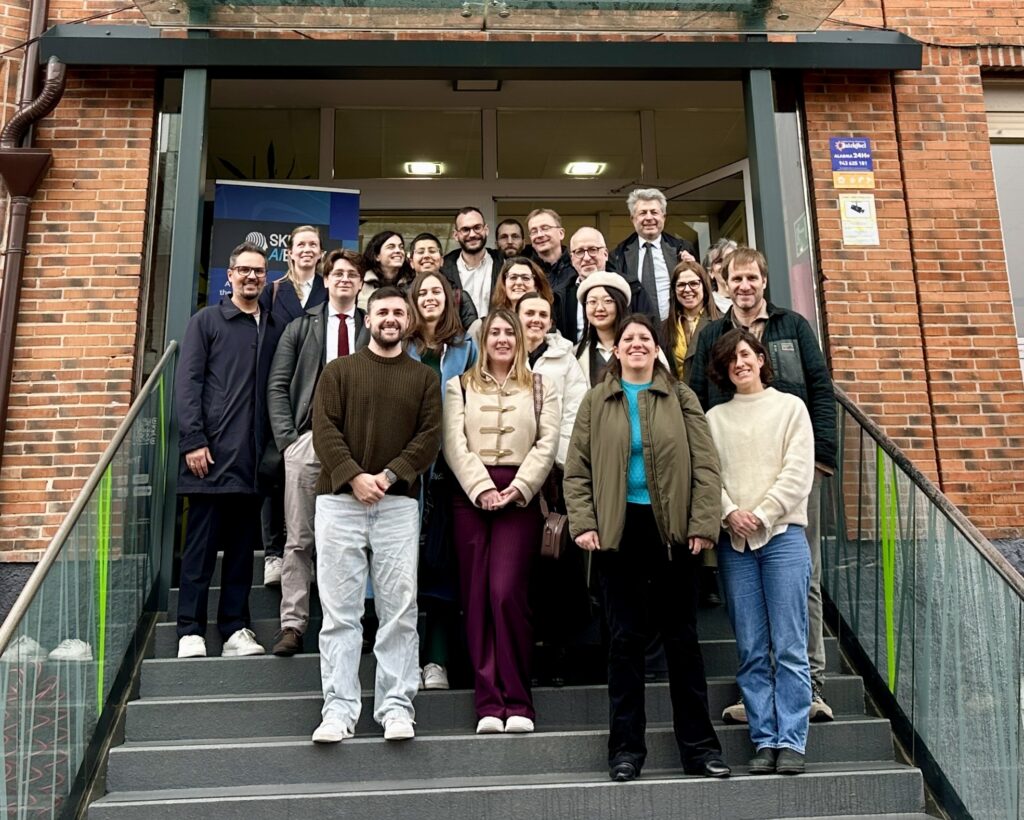
From 10 to 12 March 2026, the SkillAIbility consortium gathered in San Sebastián, Spain, for its General Assembly, hosted by Tknika. The meeting marked an important moment in the project lifecycle, bringing together partners from across Europe to review progress, align upcoming activities, and prepare for the next phase of implementation.
The meeting focused on a central question: how can emerging digital technologies such as AI, automation, virtual reality, and augmented reality be deployed in ways that strengthen human capabilities rather than marginalise workers?
Building the foundations for Industry 5.0
The project’s ambition is clear: to help employers, workers, and policymakers align digital technologies with human tasks, identify skill gaps, and design better pathways for training and inclusion. SkillAIbility aims to deliver assessment criteria, task-technology complementarity patterns, user journeys, technology design principles, policy recommendations, training programmes, and technology sandboxes to support the transition to Industry 5.0.
During the meeting, partners reviewed progress across the work packages, from needs modelling and criteria development to Learning Factory design, human-centric technology design, piloting, policy work, communication, and project management. Preliminary findings presented during the sessions show a growing need for hybrid skills that combine technical knowledge with digital, cognitive, and analytical capabilities. They also reinforce a key principle of the project: in manufacturing, AI should support human decision-making and task performance, not simply replace workers.
Putting workers at the centre
Monica Rossi from Politecnico di Milano, principal investigator and project coordinator, explained that the project set out to use artificial intelligence, virtual reality, and augmented reality to support the upskilling of workers, with a particular focus on groups who are often overlooked in digital transformation, including older people, low-skilled workers, and people with disabilities. At the midpoint of the project, Rossi noted that one of the most significant achievements so far has been a better understanding of the concrete challenges industries face in creating accessible workplaces. These include the need for assistive tools, such as exoskeletons for physical empowerment and sensor-based applications to support people with reduced mobility, as well as better methodologies to assess skill gaps and define tailored pathways for different worker profiles. She also pointed to the emergence of four key project pathways — inclusivity, symbiosis, augmentation, and empowerment — as central concepts for understanding how human-AI collaboration can be designed in practice.
From conceptual framework to practical pathways
A major focus of the general assembly was the continued development of the SKillAIbility framework. The presentations showed how the framework integrates needs, ontologies, taxonomies, workflows, and practical examples into a shared reference point for the project. It also introduces the four pathways that now structure much of SKillAIbility’s thinking:
- Inclusivity, focused on accessibility, multimodal support, and scaffolded interaction
- Augmentation, where technology enhances human task performance while preserving human control
- Symbiosis, where humans and AI collaborate through shared agency and adaptive interaction
- Empowerment, where human autonomy and expertise are prioritised with minimal system intervention
These pathways are now informing work across criteria development, Learning Factory design, pilot planning, and future roadmapping.
Learning Factories, pilots and human-centric design
Another key theme of the meeting was the role of Learning Factories as environments for testing and teaching Industry 5.0 principles. The project is using Learning Factories not only to teach technical skills, but also to explore how workers can safely and confidently interact with AI-enabled systems in inclusive and accessible ways.
The consortium also reviewed the status of pilot use cases . These include applications such as gesture-based control layers for industrial systems, AR-guided assembly, LLM-based technical tutoring for wind turbine maintenance in VET, and inclusive 3D printing Learning Factories. The use cases are already helping the consortium connect abstract concepts such as augmentation and empowerment to practical scenarios in industrial and educational settings.
In addition, the discussions reinforced the importance of designing human-centric technologies and work organisation models that safeguard worker autonomy, support diverse needs, and ensure that AI systems remain transparent and accountable. The presentation highlighted principles such as preserving meaningful human agency, designing for calibrated trust, evaluating human outcomes beyond model performance, and ensuring accessibility becomes standard rather than exceptional.
As the project enters its next phase, the work ahead will continue to focus on one core ambition: ensuring that the transition to Industry 5.0 is not only technologically advanced, but also human-centred, inclusive, and empowering.
 English
  Italian
  Spanish
  Danish
  Latvian
  Norwegian
  Greek
Greek