
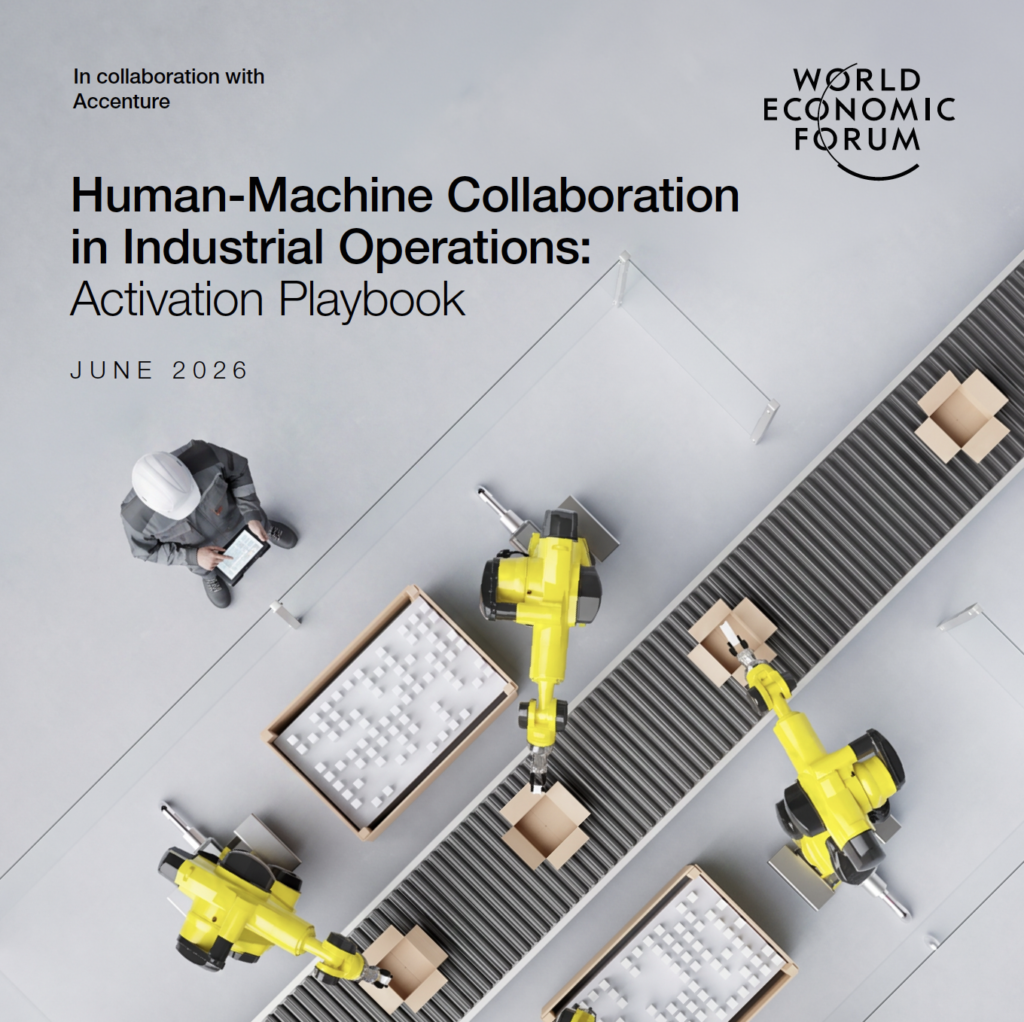
Artificial intelligence is rapidly transforming manufacturing, but technology alone will not determine the future of industrial competitiveness. According to the World Economic Forum’s new Human-Machine Collaboration in Industrial Operations: Activation Playbook, the greatest challenge facing industry is no longer deploying AI—it is preparing people to work alongside it effectively.
This conclusion strongly reinforces the vision behind our project, dedicated to helping manufacturing organisations adopt AI through human-centred workforce development, inclusive skills strategies and innovative learning environments.
The future of manufacturing depends on people and technology working together
The World Economic Forum highlights a profound shift taking place across industrial operations. As AI, robotics and autonomous systems become increasingly capable of managing repetitive and data-intensive tasks, human roles are evolving rather than disappearing.
Instead of focusing primarily on execution, workers will increasingly oversee intelligent systems, make strategic decisions, resolve complex situations and ensure that autonomous technologies operate safely, ethically and effectively. In other words, competitive advantage will increasingly depend on human judgment, creativity and problem-solving.
This represents a fundamental transition from automation replacing tasks to human-machine collaboration creating new forms of work.
Skills, not technology, remain the biggest barrier
Despite rapid advances in AI, the report identifies workforce readiness as the primary obstacle to successful transformation.
Among its key findings:
- 63% of employers identify skills gaps as the biggest barrier to business transformation.
- Nearly half of manufacturing workers are expected to require significant upskilling or reskilling before 2030.
- Organisations that invest in people alongside technology achieve substantially greater productivity gains than those focusing primarily on technology deployment.
The report argues that AI investments must be accompanied by continuous learning, skills development and organisational redesign. Technology deployment and workforce transformation should no longer be treated as separate initiatives but as a single integrated strategy.
Building trust is essential for successful AI adoption
Another important message concerns trust.
Many employees remain uncertain about how AI will affect their jobs. The report notes that concerns about job security, confidence in AI systems and leadership credibility all influence whether new technologies are successfully adopted. Workers need to understand not only how AI functions, but also how it supports their work rather than replacing it.
This is closely aligned with the principles of Industry 5.0, which places people at the centre of technological innovation and emphasises collaboration between humans and intelligent systems.
Why this matters for SkillAIbility
These findings closely mirror the objectives of the SkillAIbility project.
Across its pilot activities, research and digital tools, SkillAIbility is developing practical solutions that help manufacturing companies prepare their workforce for AI-enabled production environments. Rather than focusing solely on new technologies, the project addresses the skills, competencies and organisational practices needed to ensure that AI enhances human capabilities.
Among its key contributions are:
- the SkillAIbility Framework, supporting organisations in assessing AI readiness and workforce transformation;
- innovative Learning Factories, where workers can safely experience and develop new digital skills;
- AI-assisted and personalised learning pathways tailored to different worker profiles;
- immersive technologies such as augmented reality that facilitate practical, hands-on training;
- approaches that promote inclusion, accessibility and lifelong learning across the manufacturing workforce.
Together, these activities help organisations move from technology adoption to sustainable human-centred transformation.
From execution to collaboration
One of the report’s strongest messages is that the factories of the future will increasingly rely on collaboration between people and intelligent systems.
Workers will supervise autonomous processes, interpret AI recommendations, resolve unexpected situations and continuously improve production systems. Skills such as critical thinking, decision-making, communication and adaptability will become just as valuable as technical expertise.
Preparing today’s workforce for these evolving roles requires more than technical training. It demands new approaches to lifelong learning, organisational culture and skills development—areas that are central to SkillAIbility’s mission.
Supporting Europe’s human-centric industrial transition
As Europe advances towards Industry 5.0, projects like SkillAIbility play an important role in ensuring that digital transformation benefits both businesses and people.
The World Economic Forum’s latest report reinforces an important message: the success of industrial AI will not be measured solely by technological capability, but by how effectively organisations enable people and intelligent systems to work together.
By developing innovative training methodologies, AI-enabled learning environments and practical frameworks for workforce transformation, SkillAIbility is contributing to a future where manufacturing remains competitive, resilient and, above all, human-centric.
 English
  Italian
  Spanish
  Danish
  Latvian
  Norwegian
  Greek
Greek