
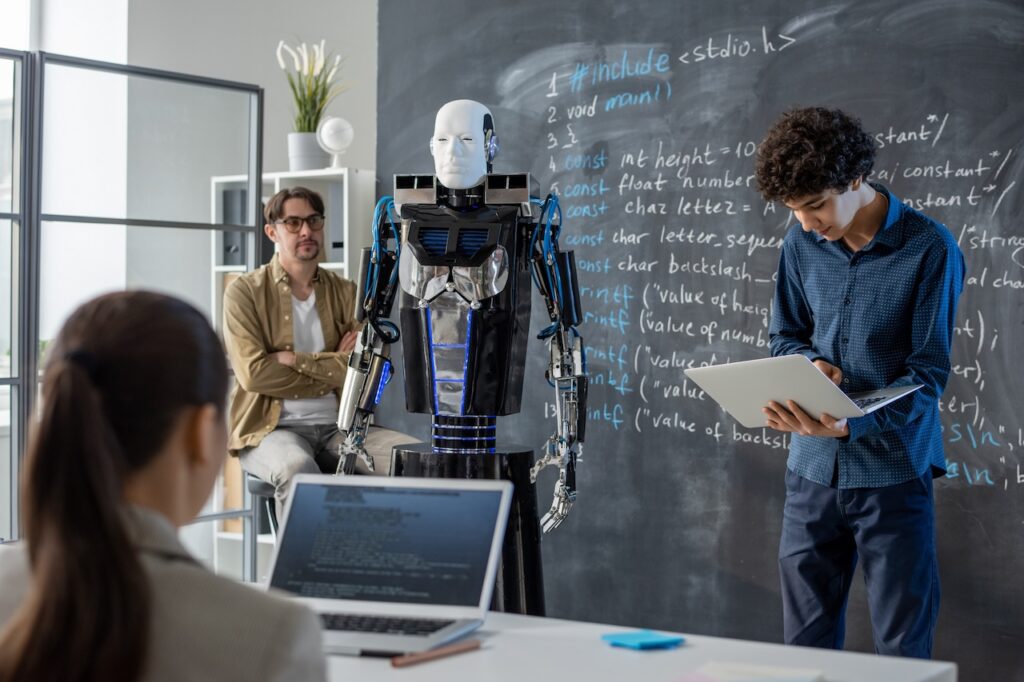
Artificial intelligence is transforming how people learn, work, and make decisions across industries. However, successful AI adoption depends on far more than technological performance. It requires trust, digital skills, inclusion, and a strong focus on human needs. Across both education and manufacturing, organisations are discovering that human-centric AI is essential for building sustainable and responsible innovation.
This is where projects such as GenAI4ED and SkillAIbility intersect in meaningful ways. Although one focuses on education and the other on manufacturing, both initiatives explore how AI can support people rather than replace them.
Human-centric AI in education and manufacturing
At first glance, schools and factories may appear to have little in common. Education focuses on teachers, students, and learning environments, while manufacturing centres on industrial processes, workforce transformation, and productivity. Yet both sectors are facing the same strategic challenge: how to integrate AI responsibly while keeping people at the centre of innovation.
In education, GenAI4ED explores the responsible use of Generative AI in secondary schools. The project combines research, stakeholder engagement, co-design, and policy guidance to help schools adopt AI ethically and effectively. Topics such as AI literacy, transparency, critical thinking, and ethical AI use are central to the project’s work.
Meanwhile, SkillAIbility addresses similar questions within the manufacturing sector. The project examines how AI and Industry 5.0 technologies are reshaping workplaces and workforce development. As highlighted in the SkillAIbility article on social and economic shifts behind human–AI integration in manufacturing, successful AI adoption requires lifelong learning, workforce empowerment, organisational resilience, and inclusive innovation.
Both projects demonstrate that AI transformation is not only technical — it is social, organisational, and human.
Why AI skills matter for the future workforce
One of the strongest connections between education and manufacturing is the growing importance of AI skills.
In schools, teachers and students need the ability to use Generative AI critically, responsibly, and safely. In workplaces, employees increasingly require upskilling and reskilling to collaborate with AI-powered systems and digital technologies.
However, AI literacy goes beyond technical expertise. Human-centric AI requires people to:
- Understand what AI can and cannot do
- Evaluate AI-generated outputs critically
- Make informed and ethical decisions
- Recognise risks, limitations, and biases
- Apply AI responsibly in real-world contexts
These competencies are becoming essential across classrooms, workplaces, and society as a whole.
Building trust in Artificial Intelligence
Trust is another critical factor in responsible AI adoption.
People do not automatically trust AI systems simply because they are innovative. Trust must be built through transparency, participation, accountability, and clear governance.
In education, teachers, parents, and students need to understand:
- Why AI tools are being introduced
- How data is used
- What safeguards are in place
- How human oversight is maintained
The same applies to manufacturing environments. Workers and organisations need clarity regarding:
- The role of AI in decision-making
- The impact on jobs and workflows
- Human supervision and accountability
- Ethical and organisational implications
Trust in AI is therefore not a secondary communication issue — it is a core condition for adoption and long-term acceptance.
Inclusion and responsible AI adoption
Another major challenge is ensuring inclusion in AI-driven transformation.
AI systems can unintentionally increase inequalities if they are introduced without considering accessibility, digital literacy, or diverse user needs. This risk exists in both schools and industrial workplaces.
Human-centric AI means recognising that people interact with technology under different social, economic, and organisational conditions. Responsible AI adoption requires implementation strategies that support:
- Accessibility
- Workforce inclusion
- Equal opportunities
- Participatory innovation
- Social wellbeing
This is why stakeholder engagement plays such an important role in both GenAI4ED and SkillAIbility. Teachers, students, workers, employers, policymakers, and communities should all have a voice in shaping how AI technologies are deployed.
Bridging research and real-world AI implementation
Both projects also highlight the importance of translating research into practical solutions.
Research findings, policy recommendations, and technological innovation only create impact when they are transformed into usable guidance for real-world communities.
For GenAI4ED, this includes:
- AI guidance for educators
- Training resources
- Policy briefs
- Educational support materials
For SkillAIbility, this involves:
- Skills development frameworks
- Human-centric manufacturing approaches
- Workforce participation models
- Organisational resilience strategies
In both cases, communication is not simply about visibility. It is about helping people understand, apply, and benefit from AI responsibly.
Industry 5.0 and the human side of AI
The growing dialogue between education and manufacturing reflects a broader European vision for Industry 5.0 and responsible digital transformation.
Both sectors are learning that sustainable AI adoption depends on:
- Human empowerment
- Lifelong learning
- Ethical governance
- Inclusive innovation
- Workforce resilience
- Public trust
As AI continues to reshape classrooms and workplaces, cross-sector collaboration becomes increasingly important. Education and manufacturing can learn from each other’s experiences in building responsible and human-centric AI ecosystems.
Ultimately, the future of AI should not be defined only by what technologies can achieve, but by how well societies prepare people to use those technologies responsibly, confidently, and inclusively.
Across schools, factories, and workplaces alike, the most resilient path forward is one that keeps human values, capabilities, and wellbeing at the centre of AI transformation.
 English
  Italian
  Spanish
  Danish
  Latvian
  Norwegian
  Greek
Greek