
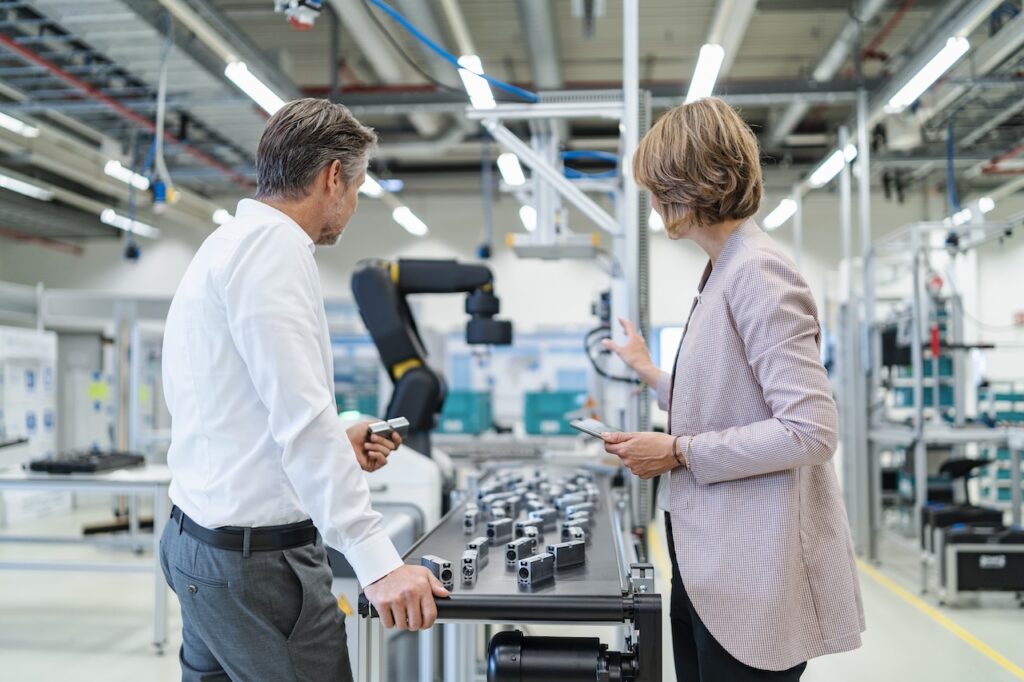
How should AI and automation be combined with human work so that technology extends what people can do? SkillAIbility answers with four pathways, now set out in the project’s framework methodology.
One technology, many workers
A cobot, an augmented-reality headset or an AI assistant does not land the same way for every worker. An experienced technician, a newly hired operator, an ageing worker and a Deaf colleague need different things from the same system: different levels of control, different amounts of guidance, different ways of receiving information.
SkillAIbility starts from this reality. Instead of asking workers to adapt to technology, the project designs technology and training around the people who use them, with a focus on those usually left out of technology transitions: people with disabilities, low-skilled and novice workers, and the ageing workforce.
The four pathways
The SkillAIbility framework methodology defines four pathways for integrating AI and automation into human work:
- Inclusività puts accessibility first: multimodal support, flexible control and step-by-step guidance. It is typically the right starting point when needs are diverse, digital confidence is low or people meet advanced technology for the first time.
- Aumento uses technology to support the task, with cognitive or physical assistance, while people keep clear control.
- Simbiosi describes humans and AI working closely together, with shared control, balanced decision authority and rich feedback.
- Responsabilizzazione prioritises human autonomy and expertise: people use advanced tools in a self-directed way, with minimal system intervention.
The pathways differ in three things: how control is shared between person and system, how much cognitive load the task places on the worker, and which modalities (visual, auditory, haptic) carry information.
Not a ladder
The pathways are not sequential stages. They are complementary design strategies that can be selected, combined or adapted. A worker may start in an Inclusivity configuration and, as skills and confidence grow, move towards Empowerment. But that progression is neither mandatory nor linear: someone may move through Symbiosis first, stay in the pathway that fits their task, or work across several at once.
This flexibility matters. It allows the same Learning Factory, a realistic manufacturing environment for training and research, to serve very different learners without lowering ambition for any of them.
From framework to shop floor
Which pathway fits is decided through assessment, not assumption. The project looks at learner autonomy and confidence, accessibility and support needs, task complexity, the desired balance between human control and system initiative, and the maturity of the organisation. The assessment draws on human factors: physical, mental, perceptual and psychosocial.
The pathways already shape SkillAIbility’s 19 use cases across five testbeds and Learning Factories. Haptic alerts for Deaf and hard of hearing operators, AR-guided assembly for people with cognitive special needs, and VR safety training for low-skilled workers each show a different pathway, or a combination of them, in practice.
As the pilots move ahead, the pathways give companies, VET providers and policymakers a shared language to plan technology that includes people rather than sorting them out.
Find out more
 Italian
  English
  Spanish
  Danish
  Latvian
  Norwegian
  Greek
Greek