
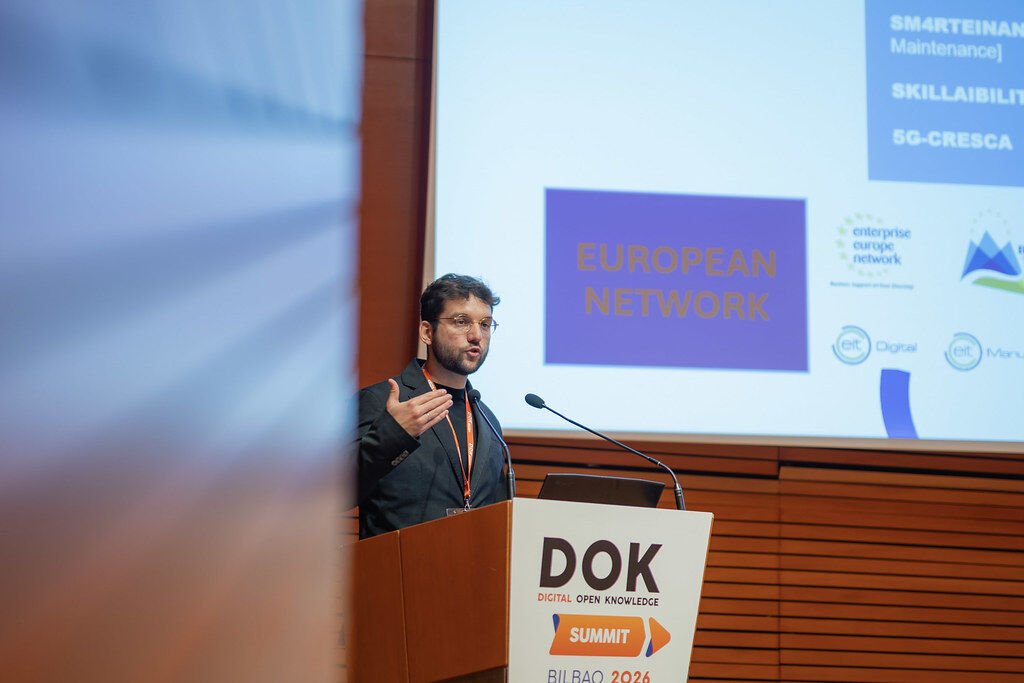
On 23 and 24 November 2026, the DOK Summit took place at the Euskalduna Conference Centre in Bilbao, Spain. The event brought together industry representatives, technology providers, policymakers and innovation stakeholders to explore the challenges and opportunities associated with digital transformation, artificial intelligence, industrial competitiveness and digital skills.
Carlo Pace, R&D Project Manager at MADE Competence Center Industry 4.0, participated in a panel dedicated to Lombardy’s ICT ecosystem, fostering an exchange of experiences with the Basque Country. Both regions have a strong manufacturing tradition and are increasingly positioning technological innovation and digitalisation as strategic drivers of industrial development.
Bringing the human dimension into industrial innovation
The summit offered an opportunity to showcase SkillAIbility as an example of how European research and innovation projects can contribute to the development of regional industrial ecosystems, promoting a more inclusive and human-centric digital transformation.
During the panel, MADE presented its perspective on Lombardy’s ICT ecosystem and its experience in supporting manufacturing companies throughout their digital transformation journey. The contribution highlighted the role of European Digital Innovation Hubs (EDIHs), particularly through the MIA2 project coordinated by MADE, alongside European initiatives such as SkillAIbility and LCAMP.
A central message of the presentation was the importance of assessing the maturity of a regional innovation ecosystem not exclusively from a technological perspective, but also in terms of the skills and competences available within the territory.
In this context, SkillAIbility was presented as a concrete example of how artificial intelligence and advanced manufacturing technologies can contribute to creating more accessible and inclusive working environments, supporting workers with different needs, abilities and levels of qualification.
The project’s approach combines technological experimentation with skills development, exploring how emerging technologies can support workers in performing industrial tasks rather than simply replacing human activities.
Key takeaways for SkillAIbility
Digital maturity is also a matter of skills maturity
One of the main reflections emerging from the exchange between Lombardy and the Basque Country concerns the relationship between technological adoption and workforce development. Access to advanced technologies does not automatically translate into successful digital transformation. Companies also need workers who can interact with these technologies confidently, as well as organisations capable of supporting continuous learning.
For SkillAIbility, this reinforces the importance of its piloting activities, which explore how solutions such as augmented reality, artificial intelligence and human–robot interaction can make industrial tasks more accessible and support workers in adapting to changing production environments.
Inclusive industrial transformation requires strong regional ecosystems.
A second takeaway concerns the importance of cooperation between companies, research organisations, training providers and intermediary institutions. These actors can collectively help bridge the gap between technological development and its practical adoption in manufacturing workplaces.
Regional innovation ecosystems can therefore play a crucial role in translating European research outcomes into tangible opportunities for companies and workers, particularly within small and medium-sized enterprises.
For SkillAIbility, this perspective is particularly relevant to the long-term exploitation and sustainability of its results. Building connections with existing industrial and innovation networks can help extend the project’s impact beyond its immediate activities.
The presentation of SkillAIbility at DOK Summit 2026 provided an opportunity to position the project within a wider European conversation on industrial transformation, reinforcing a central message: the future of manufacturing should be shaped not only by technological progress, but also by the ability to make that progress accessible, inclusive and beneficial to people.
 Latvian
 English
 Italian
 Spanish
 Danish
 Norwegian
 Greek