
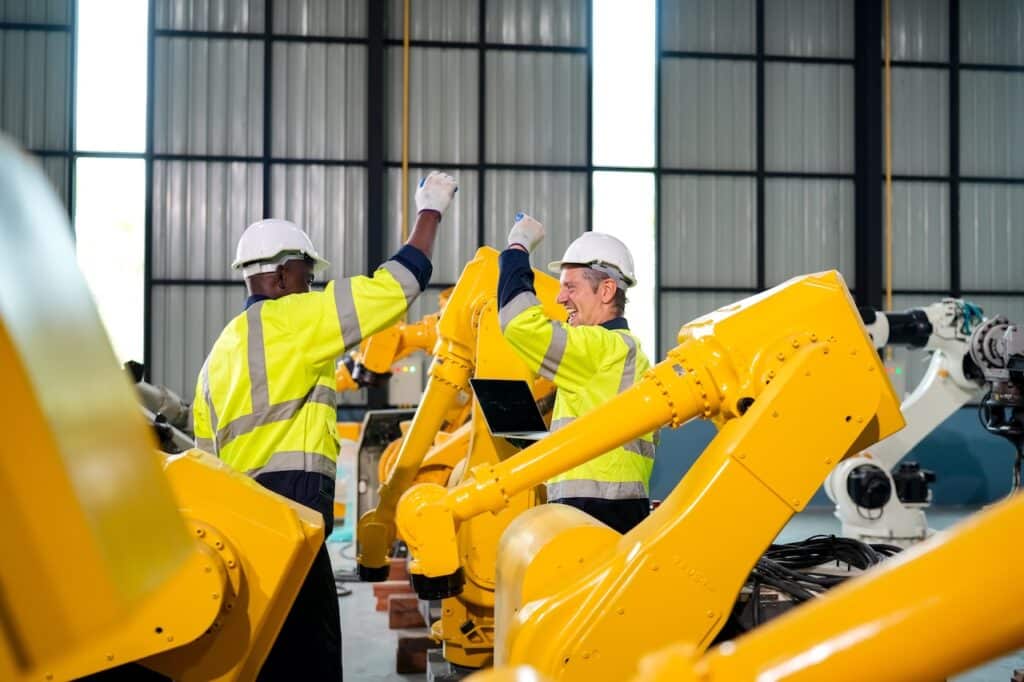
Industry 5.0 is increasingly shaping the future of European manufacturing and work. On 29 January, a multidisciplinary online roundtable brought together experts from several Horizon Europe projects to reflect on how Industry 5.0 is evolving in practice, what has been learned so far, and what still needs to happen to make it work for companies, workers, and society.
Rather than focusing on formal presentations, the discussion centred on real-world experiences, tensions, and lessons learned from implementation. The result was a shared understanding of Industry 5.0 not as a fixed model, but as a human-centred direction of change, by bringing together leading voices from five other EU Horizon Europe projects (AI REDGIO 5.0, BRIDGES 5.0, PROSPECTS 5.0, SEISMEC, and UP-SKILL), besides SKILLABILITY.
From abstract concept to real-world practice
One of the strongest messages emerging from the discussion was that Industry 5.0 is easier to recognise than to define.
Across sectors and company sizes, Industry 5.0 does not appear as a clean break from Industry 4.0. Instead, it takes shape through everyday practices: how technologies are introduced, how work is organised, and how people are involved in shaping change. Most companies do not actively use the term “Industry 5.0”, yet many are already dealing with its core challenges.
These include:
- increasing technological complexity
- skills shortages and demographic change
- sustainability and regulatory pressures
- the need for resilient and adaptable organisations
Industry 5.0 therefore emerges less as a technological upgrade and more as a new way of integrating technology, people, and organisational design.
Human centricity as the foundation of Industry 5.0
Although Industry 5.0 is often described through three pillars — human centricity, sustainability, and resilience — the discussion highlighted that human centricity is the foundation that enables the other two.
Sustainability and resilience cannot be achieved through technology or compliance alone. They depend on people’s skills, trust, acceptance of change, and ability to adapt. When workers are excluded from decision-making, even well-intended digitalisation efforts risk creating resistance, skills erosion, or long-term inefficiencies.
Human centricity in Industry 5.0 means:
- involving workers early in technology design and deployment
- co-creating training and upskilling pathways
- ensuring transparency about why change is happening
- recognising diverse needs, roles, and career stages
Rather than a single tool or method, human centricity acts as a guiding principle for transformation.
No linear transition: Industry 5.0 in mixed realities
A key learning from the roundtable was the rejection of a linear transition model from Industry 4.0 to Industry 5.0.
In reality, industrial environments consist of mixed technological and organisational landscapes. Legacy machines coexist with AI-enabled systems, digital platforms interact with manual processes, and new skills are layered onto long-established expertise. Workers navigate these hybrid environments every day.
This means that Industry 5.0 is not about reaching a predefined “end state”. Instead, it is about improving coherencebetween technology, work organisation, and human capabilities over time.
Measuring progress without reducing meaning
Several projects emphasised the importance of assessment frameworks, indicators, and benchmarks to help companies understand where they stand and where to invest. Measurement is essential to support informed decision-making and avoid fragmented transformation efforts.
At the same time, the discussion highlighted an important risk: reducing Industry 5.0 to a checklist exercise. Human-centred transformation cannot be fully captured through metrics alone. Its value often appears indirectly, for example through:
- improved employee retention
- better knowledge transfer
- higher acceptance of technological change
- stronger innovation cultures
For small and medium-sized enterprises in particular, guidance and interpretation are as important as measurement itself.
Skills, training, and learning as strategic enablers
Skills development emerged as one of the most concrete levers for advancing Industry 5.0.
Beyond technical skills, Industry 5.0 requires organisational and social capabilities: collaboration with AI systems, problem-solving in complex environments, and continuous learning. Experience from pilots and learning factories shows that training is most effective when workers actively participate in shaping it.
Learning environments that connect technological experimentation with real organisational challenges help make Industry 5.0 tangible — especially when they support inclusion and long-term employability.
Culture, leadership, and values matter
The discussion made clear that Industry 5.0 is not only about tools, technologies, or frameworks. It is fundamentally about values, culture, and leadership choices.
Technologies can support empowerment, sustainability, and resilience — but only if introduced with attention to organisational culture and social dialogue. Education systems, management training, and worker representation all play a crucial role in shaping how Industry 5.0 unfolds in practice.
Preparing future leaders and strengthening informed participation across organisations are essential to ensure that Industry 5.0 leads to better work, not just different work.
What’s next for Industry 5.0?
Looking ahead, the discussion identified several priorities for the next phase of Industry 5.0 in practice mplementation:
- consolidating knowledge and avoiding fragmentation across initiatives
- translating research insights into practical guidance for companies
- strengthening links between policy, practice, and education
- building long-term platforms and communities that outlive individual projects
Industry 5.0 is still evolving. Its strength lies in enabling continuous dialogue between technology, people, and society — grounded in practice and oriented towards sustainable and inclusive industrial transformation.
FAQ – Industry 5.0
Industry 5.0 is a European policy and innovation concept that promotes human-centred, sustainable, and resilient industrial transformation. It focuses on aligning technological progress with societal goals, ensuring that people remain at the centre of digital and industrial change.
While Industry 4.0 emphasises automation and digitalisation, Industry 5.0 focuses on how technology is used. It prioritises human centricity, sustainability, and resilience, rather than efficiency and productivity alone.
Human centricity ensures that technological change supports workers rather than marginalising them. It improves acceptance of innovation, supports skills development, and enables sustainable and resilient organisations.
No. Industry 5.0 is particularly relevant for small and medium-sized enterprises, which face skills shortages, demographic change, and resource constraints. Human-centred approaches can help SMEs manage transformation more effectively.
Companies can start by:
- involving workers in technology decisions
- investing in co-created training and upskilling
- assessing organisational practices alongside technology
- focusing on long-term value rather than short-term compliance
 English
  Italian
  Spanish
  Danish
  Latvian
  Norwegian
  Greek
Greek