
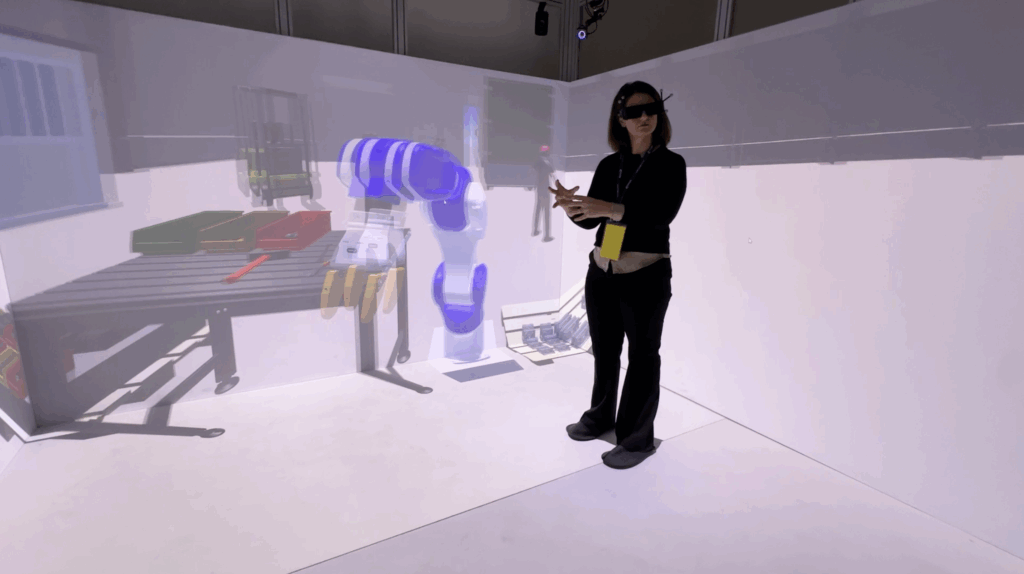
Researchers from Politecnico di Milano (POLIMI), the coordinator of the SkillAIbility project, have published new findings on how Augmented Reality (AR) and Virtual Reality (VR) can revolutionise industrial training. Their paper, “Leveraging AR/VR technologies to teach Industry 5.0 principles to students and practitioners through learning factories,” appears in the Proceedings of the Design Society, Volume 5 (ICED25).
Human-centric manufacturing in the era of Industry 5.0
Industry 5.0 goes beyond automation and digitalisation. It promotes a human-centric, sustainable, and resilientapproach to manufacturing, where humans and machines collaborate to achieve safer and more creative workplaces.
POLIMI researchers Mohammad Hossein Dehbozorgi, Monica Rossi, and Brendan Patrick Sullivan explored how Learning Factories can teach these principles effectively, preparing both students and professionals for the next industrial revolution.
Immersive learning with AR/VR and collaborative robots
The experiment took place at the MADE Competence Center in Milan, where 52 participants — students and industry practitioners — interacted with virtual cobots inside an immersive production environment.
Using AR/VR headsets, participants completed manufacturing tasks while experiencing the core Industry 5.0 values of safety, inclusivity, and empowerment.
After the session, surveys revealed:
- Increased confidence when working alongside collaborative robots
- Greater perception of workplace safety
- Stronger belief in the accessibility of AR/VR tools for industrial applications
These results confirm that immersive AR/VR Learning Factories can enhance understanding of human-centric manufacturing (HCM) concepts and prepare the workforce for the evolving needs of Industry 5.0.
Bridging academia and industry
The study highlights Learning Factories as effective bridges between academic learning and industrial practice.
Students showed the greatest improvement in perception and confidence, confirming the potential of immersive learning to build the skills, ethics, and awareness required for future Industry 5.0 professionals.
The authors conclude that integrating AR/VR technologies in Learning Factories strengthens understanding of key HCM pillars — safety, inclusivity, and empowerment — while connecting theoretical education with hands-on industrial experience.
Read the full publication
Leveraging AR/VR technologies to teach Industry 5.0 principles to students and practitioners through learning factories on our webiste or here: https://doi.org/10.1017/pds.2025.10235.
 English
  Italian
  Spanish
  Danish
  Latvian
  Norwegian
  Greek
Greek